WASHING
T-LAB

Technical cleanliness and particulate contamination analysis

At Tecnofirma’s T-LAB laboratory support companies in validating industrial washing processes through objective measurements of component cleanliness and particulate contamination analysis. Laboratory activities make it possible to verify the effectiveness of industrial washing machines and cleaning processes, ensuring compliance with the requirements of the most demanding sectors (automotive, precision mechanics, industry).

Cleanliness analysis: what we measure

We carry out specific tests to determine the level of residual contamination on components:

  • Gravimetric tests using precision scales
  • Particle size analysis by microscopy
  • Particle counting (metallic and fibrous)
  • Size classification of contaminant particles

These analyses allow the effectiveness of the industrial washing process to be quantified objectively.

Reference standards for technical cleanliness

Tests are performed in compliance with the main international standards for particulate contamination:

  • ISO 16232 – Cleanliness of components
  • VDA 19.1 – Technical cleanliness in automotive

We also operate in accordance with customer-specific technical specifications.

Equipment for industrial washing tests

The laboratory is equipped with dedicated instruments for cleanliness analysis:

  • Laboratory unit for cleanliness testing
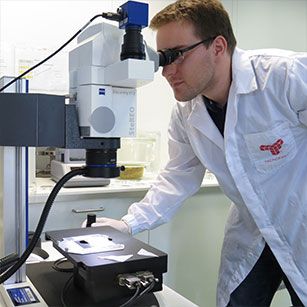
  • Microscope for particulate analysis
  • Dryer
  • Certified high-precision scales (ten-thousandth measurement resolution)
  • Washing test booth for process trials and simulations
  • Ultrasonic cleaning machine
Test methodology for contamination analysis

Laboratory tests follow standardized procedures to ensure reliable and repeatable results:

  • Placement of the component in a suitable container (stainless steel)
  • Controlled rinsing with solvent
  • Collection of the wash liquid
  • Filtration on pre-weighed filter (5–20 μm)
  • Drying and weighing of the residue
  • Microscopy analysis with counting and classification of particles
Output and laboratory reporting

At the end of the analyses we provide:

  • A data sheet for each tested component
  • A complete technical report including: results, measured and data photographic documentation
Siga-nos no: